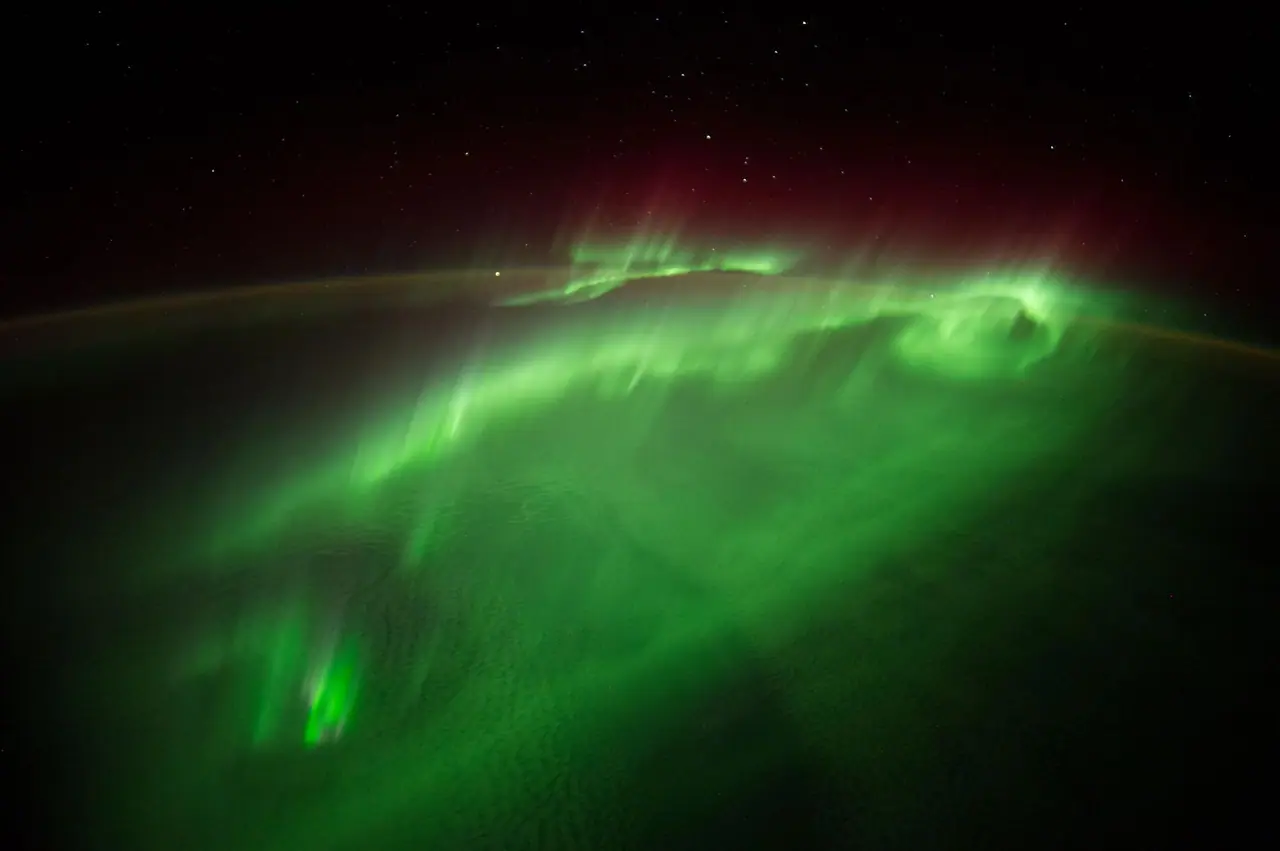
Aurora Seen From the International Space Station
Photo by Alex Gerst · Public Domain (U.S. Government work)
How it was shot
This frame is credited to Alex Gerst. According to the NASA metadata, it is part of a time-lapse sequence of Earth observation photographs taken during a night pass by the Expedition 40 crew aboard the International Space Station in 2014. Green aurora curtains ripple above the planet, which falls into darkness below.
No camera settings are published with this file. Crew time-lapse sequences are typically shot with a DSLR fixed in place at a station window, firing at short intervals with high ISO and wide apertures, because the station moves at roughly 28,000 km/h and long exposures would blur. The green comes from oxygen atoms excited by charged particles about 100–300 km up. From orbit, the station flies roughly through the top of that layer, which is why astronauts see aurora from the side.
There is a useful lesson for photographers on the ground. Aurora is often brighter on camera than to the eye, and short exposures of 2–8 seconds keep the curtain shapes sharp. If an aurora alert reaches your latitude, face the pole, use your widest lens and start at ISO 1600.