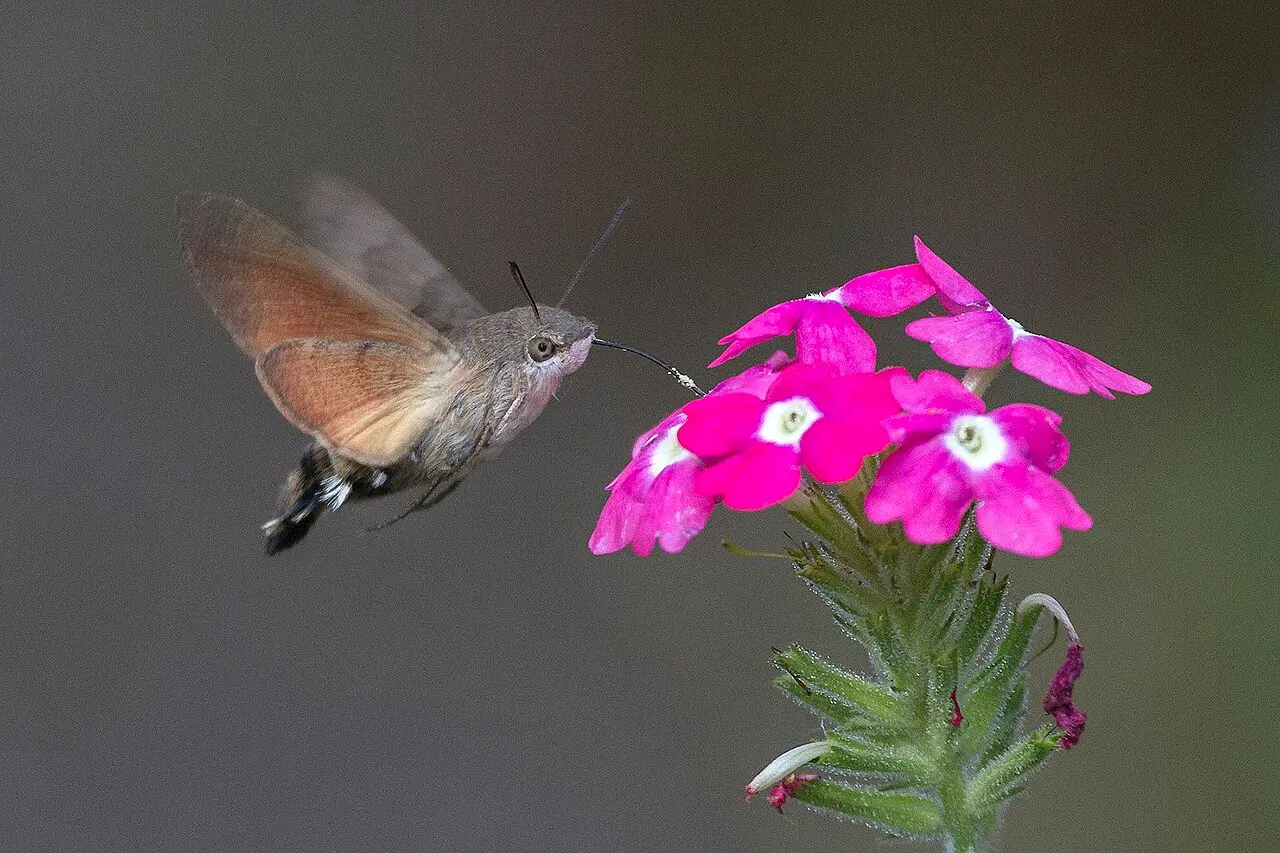
Hummingbird Hawk-Moth Hovering at Verbena
Photo by Jerzy Strzelecki · CC BY-SA 3.0
How it was shot
Jerzy Strzelecki photographed a hummingbird hawk-moth feeding on verbena in Łódź, Poland. The moth hovers in front of the flowers with its proboscis extended, like the hummingbirds it is named after. The body, eye and proboscis are sharp, while the beating wings are a translucent blur.
The camera data shows a Canon EOS-1D X with the EF 100–400 mm at 400 mm, f/6.3, 1/640 s and ISO 1250. A long telephoto rather than a macro lens makes sense for this subject. The moth is skittish and constantly moving between flowers, and 400 mm lets the photographer stay a couple of meters away. A shutter speed of 1/640 s is fast enough for the body but slow enough to leave motion in the wings, which tells the viewer the moth is flying.
The technique is to pre-focus on a flower the moth is working, then shoot bursts as it arrives. The 1D X’s fast burst rate helps. A gray, distant background keeps the pink flowers and brown moth clear. Hawk-moths often feed in late afternoon, so look for them at verbena, lavender and phlox.